Category: Local SEO Guides

  • HVAC PPC vs Local SEO: Which Is Better for Your Company?

    When an HVAC company asks where to put its marketing money, the choice is usually pay-per-click ads or local SEO. They work differently, cost differently and pay off on different timelines, and the right split depends on your season, your market and how much cash flow you can wait on. Here is how to think about it.

    The short answer

    Most established HVAC companies do best with both. Ads can put your phone number in front of a homeowner whose AC just died, starting the day the campaign goes live. Local SEO builds the map and organic rankings that keep sending calls after you stop paying per click. Which one comes first depends on whether you need calls now or are building for the next two seasons.

    What PPC does well

    • Speed. A Google Ads campaign can start producing calls within days of launch, not months.
    • Control. You choose the services, the areas and the budget, and you can raise or lower spend as the weather changes.
    • Emergency demand. During a heat wave or cold snap, people search for AC repair or furnace repair and call the first company that answers. Ads put you in that moment.

    The trade-off is that ads stop the moment you stop paying, and HVAC clicks are not cheap. In a 2026 roundup of HVAC Google Ads data, Webtonic cites a SearchLight Digital benchmark from January 2026 of about $104 per lead across all campaign types, and about $149 per lead on non-branded search, where a homeowner searches for a service without knowing your name. The same page puts Local Services Ads closer to $51 per lead. These are averages from other companies’ accounts, and your cost will depend on your area, your season and how your campaigns are set up.

    What local SEO does well

    • Compounding results. Rankings, reviews and pages keep working after they are built, without paying for each click.
    • Trust. Homeowners read reviews and check the map before they call. A strong Google Business Profile with recent reviews helps both organic and map results.
    • Year-round coverage. It benefits from both the cooling and heating seasons, and it keeps sending calls between the peaks.

    The trade-off is time. In its HVAC SEO guide, Webtonic says early gains in Google Business Profile and map pack visibility can show up in 30 to 90 days, broader organic growth usually takes three to six months, and leading positions in competitive markets can take six to twelve months. That matches what we tell clients: profile fixes can help within weeks, and strong map rankings usually build over three to six months. Our local SEO and Google Maps optimization work is built around that timeline.

    How the seasons change the answer

    HVAC demand swings with the weather. The same Webtonic guide notes that cooling searches climb from spring into late summer and heating searches climb from fall into winter. That pattern favors a split approach:

    • Keep local SEO running all year so your profile, pages and reviews are ready before each peak.
    • Raise ad spend ahead of the peaks and during extreme weather, when demand surges and a day of waiting costs you jobs.
    • Lower ad spend between the peaks, when searches drop and clicks are less likely to turn into booked work.

    What each costs with us

    Local SEO plans are $349, $749 or $1,249 a month depending on scope, with a one-time setup fee that is waived if you pay six months up front. Every plan covers one location and one website. The plans page lists what each level includes, and we break down how the plans are priced in our guide to what roofing SEO costs, which applies to HVAC as well.

    Our Google Ads management starts at $595 a month for up to $3,000 in monthly ad spend, plus a $750 setup, and the ad spend is paid to Google separately. Both can be combined, and we recommend a mix after seeing your market.

    A simple way to decide

    • You need calls in the next few weeks: start with Google Ads and fix your Google Business Profile at the same time.
    • You have a few months before your next peak: put most of the effort into local SEO now, then add ads as the season approaches.
    • You already get steady calls but want more control: keep SEO running and use ads to fill slow weeks and cover surges.
    • You are not sure: ask for an audit first. It shows how you appear on Google Maps and search today, so you spend where the gap is.

    Mistakes to avoid

    • Running ads without call tracking, so you cannot tell which clicks became booked jobs.
    • Sending ad traffic to a slow or confusing page, which wastes the click you paid for.
    • Ignoring reviews. They affect both your map ranking and whether a homeowner calls you or the next company.
    • Expecting SEO to work like ads, or ads to work like SEO. They are different tools with different timelines.

    Frequently asked questions

    Should a new HVAC company start with PPC or local SEO?

    If you need calls this month, start with a small, well-tracked Google Ads campaign and fix your Google Business Profile at the same time. The profile and reviews work is cheap, helps both channels and starts the slower SEO clock. Add pages and more SEO work as the budget allows.

    Can I turn PPC off in the off-season?

    Yes. Ads stop the moment you stop paying, so many HVAC companies raise spend before the cooling and heating peaks and lower it between them. Local SEO keeps working while ads are paused, which is why most companies keep it running all year.

    Do you guarantee HVAC rankings or a number of leads?

    No. Nobody can guarantee a Google ranking or a lead count. We report on what we can measure, such as map positions, calls and form requests, and we adjust the plan based on the results.

    See where your HVAC company stands

    If you want to know which channel fits before you spend more, ask for a free audit. We will show you how your company appears on Google Maps and search for AC repair, heating and installs in your area, and what we would do first. Request your free HVAC visibility audit, or read about our HVAC marketing work.
  • What Does Roofing SEO Cost? 2026 Prices for Roofers

    Roofing SEO does not have one price. Agencies quote anything from a few hundred dollars to several thousand dollars a month, and the right number depends on your market, your website and how much work you want done. Here is how the pricing works, what we charge, and how to judge any quote you get.

    What roofing SEO usually costs

    One 2026 pricing guide from an SEO agency, The Search Sherpa, puts roofing SEO at roughly $1,500 to $4,000 a month for most companies. It says single-market roofers sit near the low end and companies competing across a large metro sit near the high end, and it cites tiers of about $750 to $1,500 a month for a single city and $3,500 to $7,500 in the most competitive metros. Those are one agency’s published ranges, not an industry standard, and what is included varies a lot. Use them to sanity-check a quote, not as a price list.

    What drives the cost

    • How crowded your market is. A roofer in a small city competes with fewer companies than one in a large metro, so the work needed to reach the first page of results is different.
    • How many cities and services you want to rank for. Each service and city you target needs its own page with real content.
    • The state of your website and Google Business Profile. A fast site with a complete profile needs less than one that has to be fixed or rebuilt first.
    • Reviews. Roofing is a high-trust purchase, and a steady flow of recent reviews affects both rankings and whether people call.
    • Scope. A plan that only fixes your profile and listings costs less than one that also publishes pages every month or builds a new website.

    What UniLocal charges

    Our plans are priced by scope. Every plan covers one location and one website, and extra locations are $199 a month.

    • Local, $349 a month. Google Business Profile build-out, Apple Maps and Bing listings, core directory citations, monthly posts and review monitoring. It does not include website work or new pages.
    • Expansion, $749 a month. Everything in Local plus one new service or city page every month, automatic review requests, on-page SEO on your existing site and call tracking.
    • Elevate, $1,249 a month. Everything in Expansion plus a new website built in the first month, three new pages a month, and hosting, backups and content edits included.

    Setup is a one-time $499 on Local and Expansion and $999 on Elevate, and paying six months up front waives it. Extra content pages are $175 each. The plans page has the full list of what each level includes, and a roofing marketing plan is chosen after a free audit of your market.

    A roofer in a smaller market with a decent website may do well on Local or Expansion. A roofer in a crowded city usually needs more pages and more reviews, which means a higher plan or extra pages. We would rather tell you that after looking at your market than quote the same number to everyone.

    What about Google Ads?

    SEO is not the only way to get roofing calls, and ad spend is separate from any management fee. In a 2026 roundup of roofing Google Ads data, Webtonic reported about $124 per lead on non-branded search in the first quarter of 2026 (SearchLight data from 15 accounts) and cited $75 to $150 per lead for Local Services Ads from another source. Those are small samples, and your cost per lead will depend on your area and your campaigns.

    Our Google Ads management starts at $595 a month for up to $3,000 in monthly ad spend, plus a $750 setup, and the ad spend is paid to Google separately. Ads can bring calls quickly, which helps after a storm, while local SEO and Google Maps optimization build rankings that keep working without paying for every click.

    How long before it pays off

    Profile fixes can help within weeks. Strong map rankings usually build over three to six months as reviews, photos and pages add up. The Search Sherpa guide says about 90 days is usually enough to see early movement and that results tend to compound over six to twelve months. Roofing is competitive, so plan for the longer end of that range, and be wary of anyone who promises first-page rankings by a date.

    How to judge a roofing SEO quote

    • Ask what is delivered each month. Pages published, posts, review requests and reports should be listed, not described as “SEO services”.
    • Ask how many locations and websites it covers. A low price for one location is not comparable to a price for several.
    • Make sure you own everything. Your Google Business Profile, listings and domain should be yours if you leave.
    • Ask how results are reported. Calls, form requests and map positions matter more than a keyword list.
    • Be careful with guarantees. No one controls Google, so a guaranteed ranking is a warning sign.
    • Check contract length and setup fees. Know what you owe and what happens if you cancel.

    What a result can look like

    Our client Sunset Home Improvement in Easton, Massachusetts is a roofing company we work with. On October 13, 2026, a Google search for “emergency roof repairs in Easton MA” showed its emergency roofing page as the first organic result, with Sunset in the top three of the map pack. Read the Sunset Home Improvement client spotlight. Rankings change over time, and results vary and are not guaranteed.

    Frequently asked questions

    How much should a small roofing company spend on SEO?

    It depends on your market and how much your website and Google Business Profile already do for you. Many roofers start with a profile and listings plan and add pages as calls grow. A free audit shows where you stand before you choose a plan.

    Is roofing SEO worth it compared with buying leads?

    Shared leads are sold to several roofers at once, so you compete on price and speed. SEO builds a profile, pages and reviews that you own, but it takes months to build. Many roofers use both, and the mix depends on your market and budget.

    Do you guarantee roofing SEO results?

    No. Nobody can guarantee a Google ranking. We report on what we can measure, such as map positions, calls and form requests, and we adjust the plan based on the results.

    Get a price based on your market

    If you want to know where your company stands before you pay for anything, ask for a free audit. We will show you how you appear on Google Maps and search for roof repair and replacement in your area, and which plan, if any, fits. Request your free roofing visibility audit.

  • How Business Formation Services Get Found on Google

    How Business Formation Services Get Found on Google

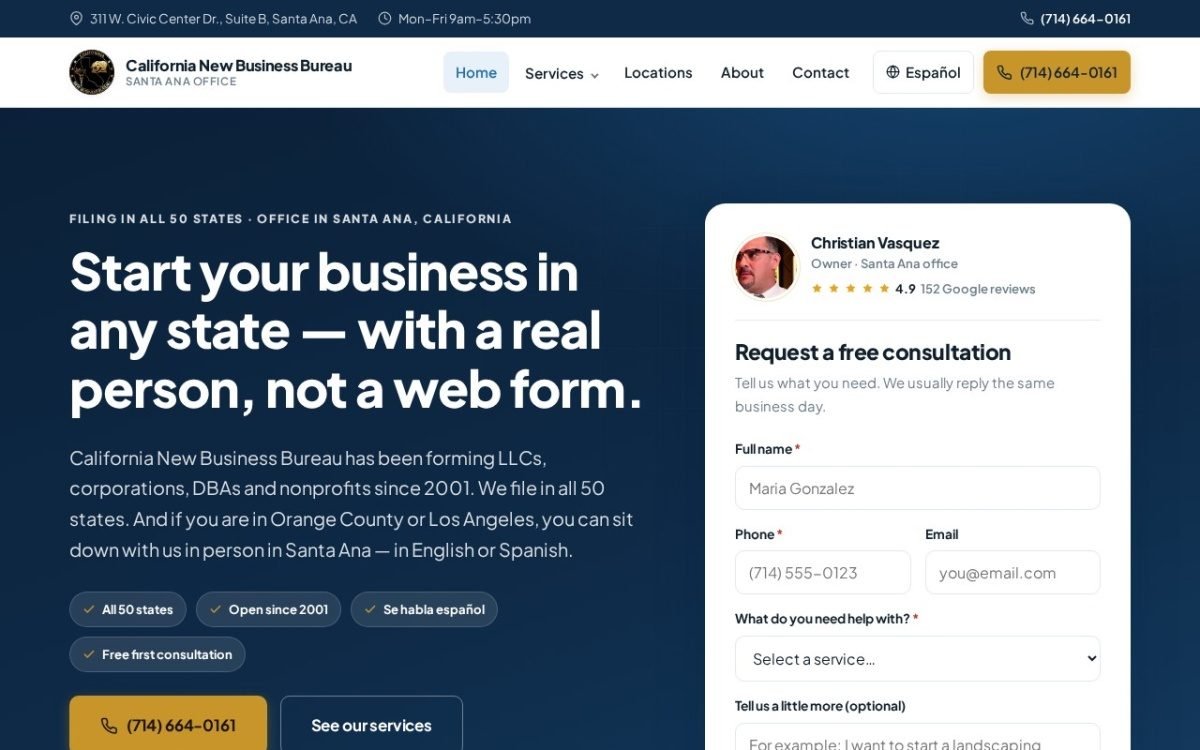
    When someone searches “how to start an LLC in California” or “file a DBA in Orange County,” they are not looking for a brand. They want a clear answer and a person they can trust with their paperwork. Here is what we have learned from building the website for California New Business Bureau, a filing office in Santa Ana.

    1. Say plainly who you are

    Filing services get confused with government agencies, and Google knows it. Put a short disclaimer on every page: you are a private service, you are not a government agency, and you are not a law firm if that is true. It protects the customer and it helps your credibility.

    2. Give every service its own page

    “LLC formation,” “DBA filing” and “incorporation” are different searches with different questions behind them. A page that explains what is filed, with whom, how long it takes and what it costs will beat a single page that lists everything. Include real, current details, such as the state filing fee, and cite where they come from.

    3. Add local pages only where you are really local

    If you have a real office, city pages can work. But each page needs something that is true for that city, such as which county office handles filings there, instead of the same paragraph with a different name. If you file for owners nationwide, say so clearly, and be upfront about any service that is limited to one state.

    4. Treat reviews and your Google listing as part of the website

    For a service people hire once, reviews are the proof. Keep your Google Business Profile complete, answer every review, and show real review excerpts on your site. Do not mark up ratings copied from another platform as structured data, because Google’s guidelines restrict it.

    5. Write in the language your customers use

    If part of your market prefers Spanish, a real Spanish version of your key pages is worth more than a translation widget. It also means customers in that market can find you in the first place.

    6. Check the rules before you pay for ads

    Google updated its government documents and services advertising policy with enforcement starting October 5, 2026. Under it, only “authorized providers” with explicit government permission can run ads that promote direct acquisition of government documents and services, and Google says registrations or entries on business registries do not count as that authorization. Whether your own ads are affected depends on how your account is classified, so read the policy page before you spend money. It is also a good reason to put real effort into the search results you do not pay for.

    Want help with yours?

    We build and maintain sites like this for local service businesses. Talk to us about your site, or read the full CNBB client spotlight.