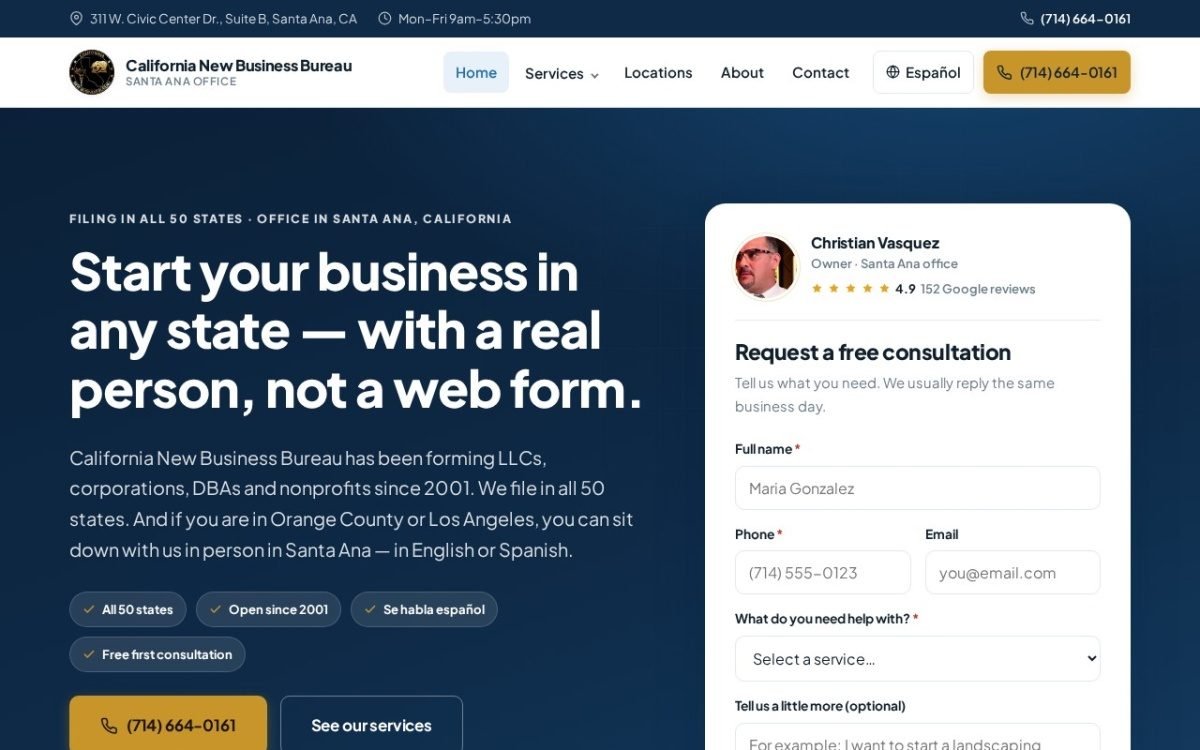
When someone searches “how to start an LLC in California” or “file a DBA in Orange County,” they are not looking for a brand. They want a clear answer and a person they can trust with their paperwork. Here is what we have learned from building the website for California New Business Bureau, a filing office in Santa Ana.
1. Say plainly who you are
Filing services get confused with government agencies, and Google knows it. Put a short disclaimer on every page: you are a private service, you are not a government agency, and you are not a law firm if that is true. It protects the customer and it helps your credibility.
2. Give every service its own page
“LLC formation,” “DBA filing” and “incorporation” are different searches with different questions behind them. A page that explains what is filed, with whom, how long it takes and what it costs will beat a single page that lists everything. Include real, current details, such as the state filing fee, and cite where they come from.
3. Add local pages only where you are really local
If you have a real office, city pages can work. But each page needs something that is true for that city, such as which county office handles filings there, instead of the same paragraph with a different name. If you file for owners nationwide, say so clearly, and be upfront about any service that is limited to one state.
4. Treat reviews and your Google listing as part of the website
For a service people hire once, reviews are the proof. Keep your Google Business Profile complete, answer every review, and show real review excerpts on your site. Do not mark up ratings copied from another platform as structured data, because Google’s guidelines restrict it.
5. Write in the language your customers use
If part of your market prefers Spanish, a real Spanish version of your key pages is worth more than a translation widget. It also means customers in that market can find you in the first place.
6. Check the rules before you pay for ads
Google updated its government documents and services advertising policy with enforcement starting October 5, 2026. Under it, only “authorized providers” with explicit government permission can run ads that promote direct acquisition of government documents and services, and Google says registrations or entries on business registries do not count as that authorization. Whether your own ads are affected depends on how your account is classified, so read the policy page before you spend money. It is also a good reason to put real effort into the search results you do not pay for.
Want help with yours?
We build and maintain sites like this for local service businesses. Talk to us about your site, or read the full CNBB client spotlight.
Leave a Reply